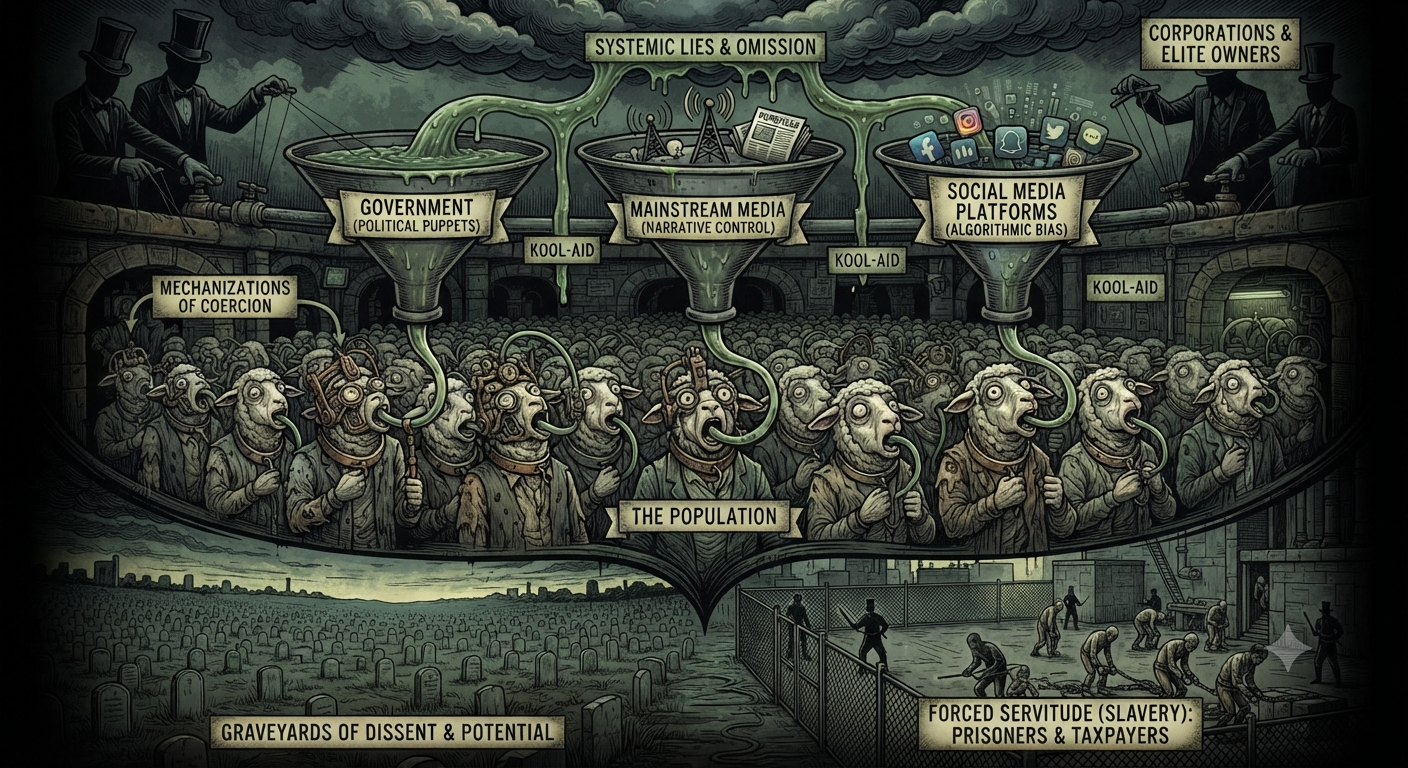
Systematic Narrative Control: A Structural Analysis of Information Suppression and Economic Incentives as Lies through Omission Functioning as a Psyop
1. Academic and Critical Frameworks of Narrative Control
Narrative control is not a fringe preoccupation of the paranoid; it is a meticulously documented sociological phenomenon essential to the maintenance of institutional stability. As a structural apparatus of elite hegemony, the management of information serves to align public perception with the requirements of capital and state power. To analyze these systems effectively, one must move beyond the reductive binary of "conspiracy" versus "accident" and instead evaluate the structural incentives that dictate the "acceptable boundaries of debate."
1.1 The Manufacturing Consent Model (Herman & Chomsky)
The core thesis of Herman and Chomsky's model posits that corporate media operates as a structural apparatus designed to filter information and manufacture public support for elite economic and foreign policy interests. This systemic outcome is achieved not through a centralized cabal, but through five deterministic structural filters:
- Ownership: The concentration of media outlets under a tiny handful of massive corporate parent conglomerates.
- Advertising Revenue: The primary financial reliance on corporate sponsors, which grants advertisers de facto veto power over content.
- Reliance on Official Sources: An institutionalized dependency on government and corporate spokespeople for "reliable" news.
- Flak: The deployment of negative responses—legal, financial, or reputational—to discipline voices that stray from the consensus.
- Anti-Ideology: The exploitation of broad ideological threats (e.g., "anti-market" or "anti-national") to marginalize systemic dissent.
1.2 Agenda-Setting Theory
Agenda-setting theory identifies a primary mechanism of social control: the media's capacity to dictate not necessarily how people think, but precisely what they think about. By establishing national priorities through high-frequency repetition and selective silence, institutions manage the cognitive horizon of the citizenry. Methods used to establish these priorities include:
- Story Omission: The strategic excision of proven solutions or contradictory evidence from the public record.
- 24-Hour Cycle Dominance: Flooding information channels with high-anxiety, low-substance content to drown out nuanced policy analysis.
- Framing: Defining the context of an issue to ensure the audience reaches a pre-determined, "safe" conclusion.
1.3 Divergence in Professional Terminology
The divergence between institutional reporting and critical analysis is fundamentally a linguistic strategy used to obscure the mechanics of influence.
- Active Intervention: Psychological Operations (Psyops) [Critical] vs. Framing / Editorial Bias [Mainstream]
- Cognitive Outcome: Behavioral Engineering / Brainwashing [Critical] vs. Groupthink / Narrative Consensus [Mainstream]
- Information Filtering: Systematic Omission / Narrative Control [Critical] vs. Sourcing Reliance / Institutional Blind Spots [Mainstream]
1.4 The "So What?" Layer: The De-politicization of Control
The choice of vocabulary documented in the terminology analysis is not aesthetic; it is a tactical sanitization. By labeling systemic behavioral engineering as "editorial bias" or "groupthink," institutions de-politicize what is essentially a psychological operation. This framing diminishes public alarm by categorizing intentional structural control as a series of professional "blind spots," thereby insulating the architecture of suppression from rigorous public investigation.
Section Transition: These abstract academic frameworks find their most chilling validation in the concrete, real-world suppression of a 30-year-old solution to the global drug crisis; represented by the HAT program implemented by the Swiss.
2. Case Study: The Swiss Heroin-Assisted Treatment (HAT) Program
The Swiss HAT program serves as a definitive "proof-of-concept" for harm reduction, providing an empirical challenge to the global "War on Drugs" status quo. Its strategic importance lies in its ability to solve—through medicalization—a crisis that the American carceral system prefers to perpetuate for profit.
2.1 The 1990s Swiss Crisis and Response
In the 1990s, Switzerland faced a catastrophic public health emergency defined by open-air drug scenes and skyrocketing crime. Rejecting the failure of the criminal justice-only model, the nation transitioned to a medicalized paradigm. This included the prescription of pharmaceutical-grade heroin under clinical supervision, treating addiction as a chronic medical condition rather than a moral failing.
2.2 Empirical Results and Data-Driven Success
Despite being a 30-year-old solution with exhaustive data, the HAT program's successes are systematically ignored in American discourse. Documented outcomes include:
- Significant Reductions in Street-Level Crime: Property and violent crimes associated with drug procurement collapsed.
- Stabilization of User Health: Participants achieved dramatic improvements in physical health and social reintegration. Editor's Commentary: The War on Drugs is what ruins the lives of a drug user far more than the drugs themselves. We will write more on these specific harms in the future.
- Neutralization of the Black-Market Lifecycle: By providing a legal, clinical alternative, the state undercut the financial foundation of illicit drug syndicates. Editor's Commentary: Prohibition is actually what creates the drug market as it produces artificial scarcity alongside heightened risk which raises the sale price of both illicit drugs & pharmaceuticals; the more a drug sells for, the more motives there are for people to sell them.
2.3 The American Media Blackout
The HAT model has been subject to an "absolute omission" from mainstream U.S. nightly news and political debate. While the American public is subjected to a constant barrage of fentanyl-related fear-mongering, this proven, decades-old solution is strategically excised from the national conversation, effectively treated as non-existent.
2.4 The "So What?" Layer: The Structural Lie through Omission
The omission of the Swiss model constitutes a "lie through omission" with a lethal body count. By editing proven solutions out of the national consciousness, the media ensures the public remains blind to the fact that the opioid epidemic is a manageable health crisis, not an inevitable disaster. This silence serves to protect the existing status quo of enforcement and sensationalism, proving that information suppression is a prerequisite for systemic failure.
Section Transition: The silence surrounding the Swiss model is a functional requirement for the financial survival of the American "People Processing Industry."
3. The Economic Architecture of the 'People Processing Industry'
The "People Processing Industry" is a self-reinforcing business model that relies on the perpetuation of the drug war for its financial lifeblood. This system maintains a commercial monopoly on the "drug market" by ensuring that both the legal pharmaceutical supply and the illegal carceral supply remain under the control of elite stakeholders.
3.1 The Carceral and Enforcement Ecosystem
The drug war is a foundational revenue stream for the carceral state. Law enforcement budgets, federal grants, and municipal resources are tied to criminalization metrics. This loop is further fortified by private prisons and probation services, which rely on a "recurring customer base" of the dispossessed, a system that functions as modern carceral, enslavement and economic peonage, (AKA slavery).
3.2 The For-Profit Recovery Complex
The American addiction market is dominated by "abstinence-only" (Podistant Moralism leading to pharmacological torture via forced sobriety) and 12-step models that often emphasize high-cost, high-recidivism cycles. The Swiss maintenance model is a direct existential threat to this for-profit recovery market. If users are stabilized through state-provided maintenance, the lucrative revolving door of rehab and relapse is effectively shuttered.
3.3 The Commercial Incentives of Media Outlets
Corporate advertising acts as an "invisible hand" over newsroom floors. Major networks depend on massive ad-buys from pharmaceutical companies, healthcare conglomerates, and institutional treatment providers. Editorial independence naturally bends to protect these commercial interests; platforms are incentivized to spike any report that suggests a low-cost, state-managed alternative to the profitable status quo.
3.4 The "So What?" Layer: The Profitability of Fear
In this economic architecture, fear is not just a byproduct; it is a commodity. High-anxiety coverage of fentanyl and crime generates higher engagement and revenue than nuanced policy deep-dives. This "Profitability of Fear" creates an entry barrier to rational policy; as long as the public is kept in a state of hyper-aroused alarm, they are incapable of demanding the calm, medicalized solutions that would threaten the "People Processing Industry."
Section Transition: While these market-driven incentives are structural, history confirms that they are often augmented by direct, coordinated interference.
4. Documented Historical Conspiracies in Information Control
Current skepticism regarding narrative management is grounded in declassified and legally proven instances of state and corporate manipulation. These are not theories; they are matters of public record.
4.1 Government-Directed Covert Operations
- Operation Mockingbird: Declassified investigations by the Church Committee in the 1970s confirmed that the CIA cultivated a network of hundreds of journalists and media executives to plant domestic and international narratives.
- COINTELPRO: The FBI utilized fabricated stories and media manipulation to systematically disrupt, discredit, and dismantle domestic social movements.
- Wartime Control: From the Creel Commission to modern embedded-media protocols, the state has historically used classification and managed access to ensure war narratives align with military objectives.
4.2 Corporate and Oligarchic Collusion
- The AP Antitrust Case (1945): The Supreme Court ruled against news conglomerates for concerted behavior designed to block independent reporting and monopolize news distribution. Editor's Commentary: Clearly this was a total failure as the so-called "Justice System" often is.
- The Tobacco and Fossil Fuel Playbooks: Landmark litigation proved that these industries conspired to fund front groups and pseudo-science to suppress research on product harms, leveraging media to treat established safety facts as "controversial."
4.3 The "So What?" Layer: Active Conspiracy vs. Systemic Design
The distinction between an active conspiracy and "Systemic Design" has blurred over time. As ownership has hyper-concentrated, the need for "smoke-filled rooms" has diminished. The economic architecture now ensures that only "safe" perspectives reach the production floor, meaning the system is now largely self-policing, with the boundaries of debate enforced by the sheer weight of concentrated capital.
Section Transition: These historical tactics have evolved into a unified, modern systemic loop where capital, law, and information are indistinguishable.
5. The Unified Systemic Loop: Capital, Law, and Information
The modern landscape is defined by a "corporate fascist agenda"—an integrated circuit where legislation, lobbying, and media ownership merge to protect the interests of the rich at the expense of the majority.
5.1 The Legislative Pipeline (ALEC and Think Tanks)
Through the American Legislative Exchange Council (ALEC), corporations draft "model bills" behind closed doors. These laws are then handed to lawmakers to be passed without meaningful public oversight, ensuring that the legal framework for the drug war and carceral expansion is written by those who profit from it.
5.2 Lobbying and Campaign Finance Ecosystems
The "cost of doing business" includes the systematic purchase of politicians and think tanks. Billions in campaign finance ensure that the status quo remains profitable for the defense, pharmaceutical, and carceral sectors, rendering the legislative process immune to empirical evidence or human suffering.
5.3 Media Consolidation: The Big Parent Conglomerates
A tiny handful of conglomerates control the majority of information: Comcast, Disney, Warner Bros. Discovery, Paramount, and Sony. Crucially, Amazon now plays a pivotal role, not just in content but in the digital infrastructure and cloud hosting that underpins the entire information ecosystem, granting it immense leverage over the visibility of dissent.
5.4 Social and Algorithmic Architecture
Digital platforms perform a "lie through omission" identical to traditional media. "Shadow-banning," the demonetization of dissent, and "outrage loops" are designed to maximize time-on-site while filtering out systemic critiques. This digital behavioral engineering ensures that the "sheepish majority" remains trapped within a managed cognitive environment.
5.5 The "So What?" Layer: The Self-Policing Nature of the Loop
This loop is inherently self-policing. The economic architecture ensures that only "safe" perspectives—those that do not threaten the profitability of mass enslavement or resource extraction—reach the megaphone. It is a system that filters out the wisest voices by design, ensuring that the "corporate fascist agenda" remains unchallenged by the general public.
Section Transition: This unified system operates within a unique legal vacuum that grants corporations powers the state is theoretically denied.
6. Legal Distinctions and Societal Impact
A profound regulatory blind spot allows corporate entities to perform "behavioral engineering" that would be strictly illegal if conducted by the state.
6.1 Statutory Prohibitions vs. Corporate Freedom
While federal statutes prohibit domestic military "psyops" targeting citizens, there are no laws preventing corporations from using advanced data science and algorithmic manipulation to achieve the same ends. As private entities, they are free to manage public perception and suppress life-saving information under the guise of "platform management" and "corporate freedom."
6.2 The Human Toll of Narrative Suppression
The suppression of models like the Swiss HAT program results in a staggering human cost:
- Preventable Overdose Deaths: Hundreds of thousands of lives lost to a "monopoly on drugs" that prioritizes profit over health.
- Mass Enslavement: The continued expansion of the "People Processing Industry" and carceral budgets.
- Wealth Extraction: The systematic drainage of public resources through taxation into the coffers of the carceral and pharmaceutical sectors. Editor's Commentary: Slavery via taxation to pay for practices that effectively physically express as legalized forms of terrorism, theft, kidnapping, blackmail & psyops, do they not?
6.3 The Risk of Revolutionary Conflict
When peaceful avenues for systemic correction are structurally gridlocked by corporate interests, the social contract reaches a "critical breaking point." When the state and its media proxies ignore 30 years of empirical success in favor of maintaining a "corporate fascist agenda," they invite structural ruptures. The current trajectory points toward a revolutionary war as the only remaining mechanism for systemic correction.
6.4 The "So What?" Layer: Reparations for Systemic Negligence
The current system is not merely failing; it is performing a form of criminal negligence at best or crimes against humanity at the worst. Addressing this requires more than minor reform; it demands a "complete paradigm shift" and reparations for those whose lives and communities have been destroyed by the People Processing Industry. Reparations are not a charity but a societal necessity for decades of systemic negligence and the intentional suppression of known solutions.
Final Statement: The observation and documentation of these interconnected systems is the fundamental prerequisite for achieving the societal change necessary to dismantle institutionalized oppression. We must also note, at the causal core, all of these issues represent the failures of Democrazy, free-market capitalism, the cult of opinionism, the cult of greed & most of all the oppression/sabotaging of the wise minority who serve as the voices of dissent. We must all face that reality is complicated & those who serve as examples of the most intelligent and/or wise are those who have the capability to understand reality well enough to formulate the effective curative solutions; more importantly, note that those in nearly every position of power are not examples of the necessary levels of wisdom required to be competent leaders of anything at all.